Carl Sagan's dream of landing on comet came true:
http://blogs.esa.int/rosetta/2014/11/12/touchdown-confirmed-for-philae-at-1703-cet/
Space history made.
There is a theory which states that if ever anyone discovers exactly what the Universe is for and why it is there, it will instantly disappear and be replaced by something even more bizarre and inexplicable. There is another theory which states that this has already happened ...
Wednesday, November 12, 2014
Tuesday, July 22, 2014
45 years later
Apollo 11 splashing down in Pacific on July 24 1969 fulfilled President Kennedy challenge of sending a man to the Moon and safely returning him home. It proved that it is possible for humans to set an ambitious goal and reach it.
Interestingly that goal was set up not from necessity but from the pure spirit of competition. We have a number of challenges on Earth and beyond we as a humankind have to resolve now - from ending senseless bloody wars to overcoming global pollution bringing to the tipping point of irreversible climate change. Sadly, it does not seem to inspire any world leader to take a challenge of "by the end of the decade to end dependency on the fossil fuels" or similar, which would be a great and worthy cause.
45 years ago a young boy back in the Soviet Union proud of Sputnik and Gagarin, dreaming to become a Cosmonaut, read about "Americans" on the Moon and felt devastated and betrayed. Now I feel betrayed again.
Gene Cernan, commander of the last Apollo mission leaves the lunar surface with these words: "We leave as we came and, god willing, as we shall return, with peace, and hope for all mankind." The bootprints of Apollo are still waiting for company...
Thursday, October 3, 2013
Something about this day
Strangely, every year I find more facts about October 4.
See my previous posts: OCTOBER 4 and about SpaceShip One
Now, I was looking for a something for my blog and came across another fact:
Construction of the first experimental prototype, Versuchsmuster 1, of the German rocket-powered vertical take-off interceptor Bachem Ba 349 Natter was completed on October 4, 1944. Weird coincidence, but nevertheless...
Is there something special about this day, October 4th ?
See my previous posts: OCTOBER 4 and about SpaceShip One
Now, I was looking for a something for my blog and came across another fact:
Construction of the first experimental prototype, Versuchsmuster 1, of the German rocket-powered vertical take-off interceptor Bachem Ba 349 Natter was completed on October 4, 1944. Weird coincidence, but nevertheless...
Is there something special about this day, October 4th ?
Sunday, July 21, 2013
44 Years Ago ...
44 years ago today, humans landed on the Moon for the first time. A
Raytheon-MIT guidance computer enabled Apollo 11 in its journey, and its
on-board microwave tube transmitted radio and TV signals to Earth,
enabling millions to witness history live when astronauts Neil Armstrong
and Colonel Edwin Aldrin stepped onto the Moon. The Apollo Guidance
Computer gained the reputation of the most reliable digital computer of
its time.
Proud to have worked at Raytheon and studied at M.I.T.
Thursday, October 4, 2012
Ascent
55 years ago the first man-made satellite was launched onto Earth orbit.
This article was published on the 50th anniversary of Sputnik:
Sputnik and The Dawn of the Space Age
The other interesting article about what followed next:
The history of solar cells

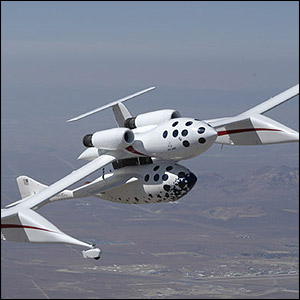
On October 4 2004, Spaceship One won the US$10 million X-Prize by reaching 100 kilometers in altitude twice in a two-week period with the equivalent of three people on board and with no more than ten percent of the non-fuel weight of the spacecraft replaced between flights. Spaceship One, the first commercial piloted space vehicle, was developed by Scaled Composites, funded by Paul Allen.

There is a number of new technologies other than photo-voltaic modules, which either stem directly from the developments originally implemented in space or were instigated by the space exploration projects and which found or finding implementation in Earth applications:
vacuum UV solar thermal systems, electro-chemical energy storage systems, fuel cells, ultra-light materials, optimal control systems and number of others.

more on my profile
This article was published on the 50th anniversary of Sputnik:
Sputnik and The Dawn of the Space Age
The other interesting article about what followed next:
The history of solar cells

On October 4 2004, Spaceship One won the US$10 million X-Prize by reaching 100 kilometers in altitude twice in a two-week period with the equivalent of three people on board and with no more than ten percent of the non-fuel weight of the spacecraft replaced between flights. Spaceship One, the first commercial piloted space vehicle, was developed by Scaled Composites, funded by Paul Allen.

There is a number of new technologies other than photo-voltaic modules, which either stem directly from the developments originally implemented in space or were instigated by the space exploration projects and which found or finding implementation in Earth applications:
vacuum UV solar thermal systems, electro-chemical energy storage systems, fuel cells, ultra-light materials, optimal control systems and number of others.

more on my profile
Saturday, September 3, 2011
OCTOBER 4
The first man-made satellite, Sputnik was launched into orbit on October 4, 1957.
The first super-jet Avro Arrow was rolled out of the factory on October 4. 1957.
Vladimir Grebenyuk was born on October 4, 1957.
Subscribe to:
Posts (Atom)